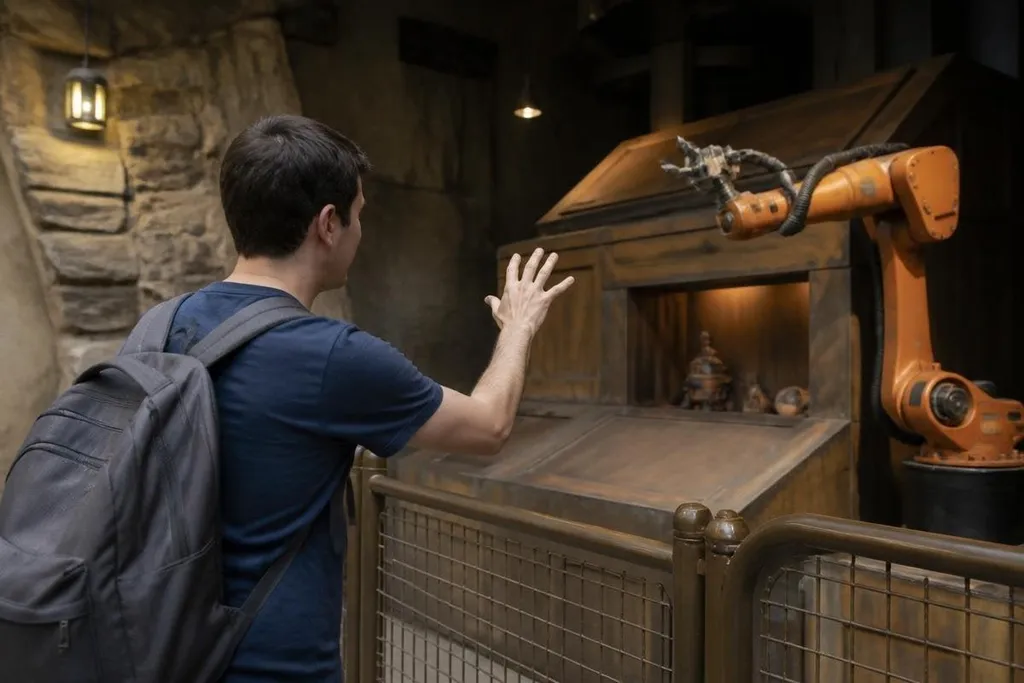
A robot can make an attraction react to a visitor’s movement, voice, or position. That lets the visitor affect a scene instead of watching the same fixed sequence, though the effect depends on timing, safety, and repeatable control.
- Sensors can let scenes respond to a visitor’s position.
- Moving props can add touch, motion, and sound.
- Human operators may still be needed when robots face unusual situations.
The robot becomes part of the scene
A moving robot gives an attraction a physical response that screens cannot provide on their own. A robotic arm can turn a prop, point toward a visitor, or change its motion after a sensor detects someone nearby.
That response works best when the action has a clear reason. A creature that looks toward a person after hearing their voice feels connected to the scene. The same creature moving on a timer can feel like equipment running through a cycle.
Sensors do the first part of the work. Cameras can track position, microphones can detect sound, and proximity sensors can tell when someone is close to a moving part. Software then sends commands to motors, lights, or speakers.
Timing matters as much as movement. If a robot reacts several seconds after a visitor steps into a zone, the connection weakens. A short delay can make the system feel broken rather than responsive.
Touch adds something screens cannot
Physical motion gives visitors another way to experience a story. A door can resist before opening, a platform can tilt within safe limits, or a robotic prop can hand over an object under staff control.
The force has to stay controlled. A robot used near the public needs limits on speed, torque, and reach, along with an emergency stop that staff can reach quickly.
The attraction also needs a safe response when a sensor fails or a visitor steps into the wrong area. This is where design and engineering meet. A machine may need a soft outer surface, reduced motor force, and a restricted movement zone.
Those choices can reduce the range of motion, but they also make the attraction easier to run around people. Sound and light can support the motion. A robot turning its head while a speaker plays a matching sound gives the visitor more information than either action alone.
The parts need a shared clock so that the movement and audio start together.
Robots can change between visits
A fixed ride gives each visitor the same sequence. A robot linked to sensors can change small details based on location, group size, or earlier actions, provided the system has clear rules for each case.
That variation can make repeat visits feel different. It can also make testing harder because staff need to check every allowed state, not one perfect run. The attraction needs logs that show which sensor event caused each robot action.
Teleoperation gives staff a way to handle cases the automated system can’t. An operator can guide the robot around an object, pause the scene, or reset it after an unexpected event, then log why they stepped in. Reports on robot control from Robot24.com can show how often attractions need that support and what the operator must see before taking control.
The operator still needs a clear view of the machine and its surroundings. Cameras, status lights, and a manual stop can matter more than a complex feature that visitors never notice.
The limits are physical
Robots add moving parts, and moving parts need inspection. Dust, repeated impacts, cable wear, and motor heat can change how a system behaves across a long day. A design that works for a short demonstration may need different maintenance for daily public use.
Crowds also create hard cases. People move at different speeds, children may reach toward props, and visitors may block a sensor. The robot has to pause or choose a safe action when its view is unclear.
The unproven part is the business value. A robot may make a scene more memorable, yet that does not show whether visitors will pay more, stay longer, or return. Those results need measured visitor data from the attraction itself.
I'd favor robots that support one clear story action over machines added for motion alone. The robot earns its place when its movement changes what the visitor understands or feels.
A practical decision guide
Before adding a robot to an attraction, check these points:
- Define the visitor action: decide what the person does and what the robot must sense.
- Set safe limits: record speed, force, reach, stop time, and the protected area.
- Plan the failure state: choose what happens when power, vision, audio, or network control fails.
- Measure the result: track wait time, repeat visits, stoppages, and staff interventions.
- Price the upkeep: include inspection, spare parts, cleaning, software work, and operator time.
The strongest attraction will be the one where the robot’s action remains useful after the first visit. Until operators can show that result with visitor data and stable daily running, the machine is an added scene effect, not a reason to rebuild the whole attraction.